
Site Surveys in ERCOT: Where Projects Are Won or Lost
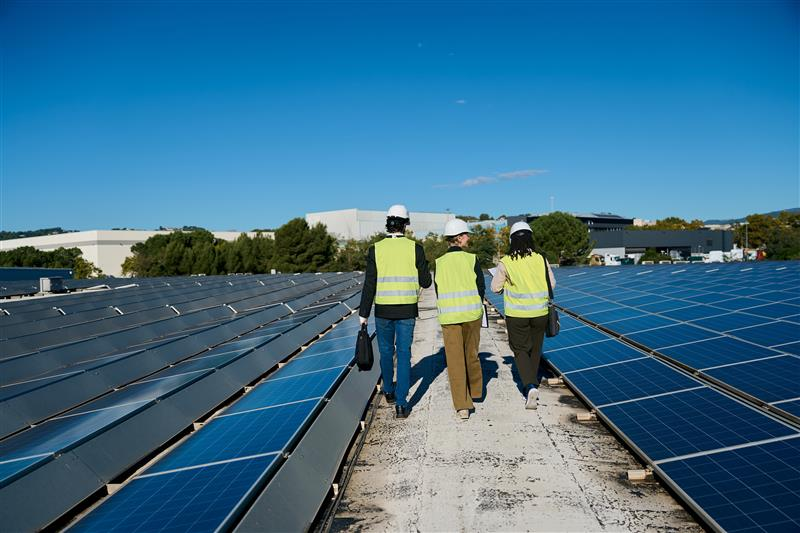
In the ERCOT renewable market, project readiness no longer means a signed lease and a preliminary layout. It means something simpler, and far more unforgiving: verified site conditions.
For years, site surveys were treated as procedural. Walk the site, take photos, move on. That approach doesn’t survive today’s commercial solar and C&I storage environment in Texas. The margin for error is gone.
In ERCOT, early site verification is no longer a preliminary step. It is a control point, the moment where a project either becomes constructible or quietly begins accumulating future change orders.
Why This Shift Matters Now
ERCOT development has moved upstream.
Design decisions that once lived safely in construction (equipment placement, MV routing, underground coordination)are now expected to be resolved before procurement and interconnection finalization.
Why? Because the cost of being wrong has exploded.
Switchgear lead times are long.
Feeder capacity is tighter.
Brownfield complexity is the rule, not the exception.
A bad assumption no longer causes a minor redesign. It triggers study revisions, equipment mismatches, and stop-work orders.
Takeaway: In ERCOT, inaccurate site data doesn’t slow projects, it breaks them.
The Reality of Texas C&I Sites
Most commercial solar and storage projects in Texas are brownfield developments: operating facilities layered with decades of undocumented infrastructure.
As-built drawings are often aspirational. Fire loops get rerouted. Private gas lines appear where no record exists. Old conduits are abandoned without updates.
These risks don’t show up on satellite imagery. They surface when excavation begins, when design flexibility is already gone.
Takeaway: The ERCOT market rewards speed. Brownfield sites punish assumptions.
What Advanced Site Surveys Actually Prevent
Consider a typical 2MW BESS or solar-plus-storage project.
Civil risk: Uncompacted fill beneath a container pad. A buried fire loop three feet below grade. Neither shown on legacy plans.
Electrical risk: Existing switchgear with no physical bus space for a tap. AIC ratings insufficient for added fault contribution.
Logistical risk: Transformer access blocked by overhead lines or clearance constraints invisible in desktop reviews.
Any one of these can stall a project for months; not because equipment is late, but because excavation exposed reality.
By then, the gear is ordered. Crews are mobilized. Every day burns contingency.
Takeaway: Most ERCOT delays aren’t technical failures. They’re verification failures.
What Advanced Site Survey Means in Practice
At Illumine-i, an advanced site survey is not a photo exercise. It is a multi-disciplinary engineering validation.
Electrical Verification
Physical inspection of busbars, not just panel label
Fault duty confirmation for solar and storage contributions
Real conduit routing, including firewalls, plenums, and derating constraints
NEC working space verification before equipment placement
Structural & Constructability
Roof framing validation (truss vs. purlin, membrane condition, warranty impacts)
Soil and pavement assessment for containerized storage
Access and rigging feasibility for heavy equipment
This data establishes the baseline physics for every downstream decision.
Takeaway: Engineering without verified site data is speculation with CAD files.
Case Study: Survey-Led Risk Reduction on a 2 MW ERCOT Project
The Situation
A 2 MW commercial solar project was awarded with limited documentation. A preliminary layout was developed to support early planning.
What the Survey Found
During the pre-design site survey, the proposed transformer location was flagged. An underground pipeline (absent from available drawings) ran directly beneath the planned pad.
The Engineering Response
Because this was caught early:
The transformer and switchgear were relocated in design
Duct bank routing was adjusted within voltage-drop limits
Equipment access and rigging were revalidated
The Result
Zero construction delays
No civil change orders
Avoided a six-figure pipeline relocation
Procurement proceeded with confidence
Takeaway: Moving equipment on paper costs hours. Moving it in the field costs months.
Why This Matters Heading into 2026
ERCOT projects are entering a phase defined by higher scrutiny and lower tolerance for error:
Feeder saturation will demand precise electrical data
Utilities will expect constructable designs earlier
Greenfield flexibility will continue to shrink
Brownfield complexity will dominate
Site surveys are what make this environment survivable.
They convert financial models into buildable systems, and assumptions into facts.
Final Word
In ERCOT, site surveys are no longer a checkbox. They are the foundation of reliable design.
Projects that rely on desktop assumptions will continue to bleed time and capital. Projects that verify early will move faster, procure smarter, and build cleaner.
Engineering Done Right doesn’t start in CAD. It starts in the field.
ERCOT projects that move forward do so on verified data. Illumine-i delivers site-first engineering for ERCOT solar and storage projects. Get in touch.


Comments